REVIEW · MORELIA
3 Magic Towns: Tzintzuntzan, Patzcuaro & Santa Clara del Cobre
Book on Viator →Operated by Alfredo Tour Guide · Bookable on Viator
Three Pueblos Mágicos in one day. You’ll bounce between volcanic-rock ruins, artisan lacquerwork, and copper crafts tied to the 1968 Olympic flame. It’s a compact hit of Michoacán without needing to rent a car.
What I like most is how the stops are built around different “ways of seeing” the region. I especially like the brief but focused time at Tzintzuntzan and the Santa Ana Franciscan ex-convent, then the chance to spend time in the Casa de los Once Patios with makers doing lacquer work and gold-leaf inlay.
One drawback to plan for: this is a fast 8-hour loop, and the tour doesn’t include lunch. Bring comfortable shoes and be ready for walking through old-town streets and archaeological areas.
In This Review
- Key points before you go
- Price and logistics from Morelia (and what you’re actually paying for)
- How the 8-hour loop fits together (and why the timing feels tight)
- Stop 1: Tzintzuntzan Archaeological Zone and the volcanic-rock foundations
- Stop 2: Plaza Vasco de Quiroga in Pátzcuaro—Spanish homes, no church around the square
- Stop 3: Casa de los Once Patios—meet artisans making gold-leaf lacquer
- Stop 4: Santa Ana Franciscan ex-convent—1533 murals and reused volcanic stones
- Stop 5: Santa Clara del Cobre—copper shops and the 1968 Olympic flame basin
- Alfredo Tour Guide and why this day feels “guided” instead of rushed
- What to watch for on the day: walking, timing, and lunch planning
- Who this tour suits best (and who might want a different plan)
- Should you book 3 Magic Towns from Morelia?
- FAQ
- How long is the tour?
- What does the tour cost?
- Where do we meet for the tour?
- Does the price include lunch?
- Is admission included for the stops?
- Is the guide available in English?
- What’s the group size limit?
- What’s the cancellation policy?
Key points before you go
- Small group (max 8) keeps things manageable and lets the guide steer the day.
- Private, air-conditioned transport means less stress on longer drives.
- Admissions included at two major stops (Tzintzuntzan ruins and the Santa Ana ex-convent).
- Gold-leaf lacquer time at Casa de los Once Patios gives you a maker-focused stop, not just a photo stop.
- A single story connects the day: indigenous roots, early Spanish influence, and living copper craft.
- Alfredo’s bilingual guidance adds a lot of context to what you’re looking at.
Price and logistics from Morelia (and what you’re actually paying for)
At $99 per person, this isn’t a “bare minimum” tour. You’re paying for private transportation, an English-speaking guide, and a day designed around three destinations that would be harder to link without a car. The route starts in Morelia and ends back at the same meeting point, so you’re not dealing with complicated transfers.
The tour runs about 8 hours and starts at 9:00 am. Your meeting point is Burger King Morelia Centro 2, at Guillermo Prieto 30, Centro histórico de Morelia (58000). You’ll get a mobile ticket, and the group size is capped at 8 people, which usually makes the pacing feel more human than big-bus chaos.
Lunch isn’t included, so you’ll want to think about when you’ll eat. In practice, the day is scheduled by short site visits (10 to 30 minutes each), and that means you’ll likely want a place picked in advance—or at least a plan to eat after the tour or during any break the guide suggests.
One more practical note: the tour lists a moderate physical fitness level. That’s code for: you don’t need to be an athlete, but you should be comfortable walking on uneven ground and navigating archaeological areas and historic streets.
You can also read our reviews of more tours and experiences in Morelia.
How the 8-hour loop fits together (and why the timing feels tight)
This itinerary is built like a greatest-hits sampler. You’ll hit five stops—two with included admission tickets and three that are free to enter. Each visit is timed, so you’ll see a lot, but you won’t have long “wander time” to soak in every corner.
That can be perfect if your goal is: see the key sights, understand what you’re looking at, and move on while you’re still energized. It can be frustrating if your dream day includes slow, extended wandering in just one town—especially since Pátzcuaro’s stop is short.
I also like that the day mixes ruins, Spanish-era religious architecture, and living craft. It gives you a clearer picture of how Michoacán’s past connects to what’s happening today, rather than treating each stop like an isolated postcard.
Stop 1: Tzintzuntzan Archaeological Zone and the volcanic-rock foundations
Your day starts at the Zona Arqueologica de Tzintzuntzan. This is the first “wow” moment, with admission included and about 30 minutes on site.
The standout detail here is the volcanic-rock construction. The foundations for temple structures date back to the 1470s, which gives you an immediate sense of age and continuity. Even with limited time, volcanic rock has a distinct look and feel, and you’ll be able to spot how the site is built and how the stonework shapes the space.
The practical side: archaeological zones often mean uneven ground and some walking between viewpoints. If you’re sensitive to heat or walking distance, plan to keep your stops efficient—take your main photos fast, then spend the rest of the time looking at the structure.
Since this is only a half-hour, go in with one simple goal: understand the basic layout and what the stone foundations tell you about the way these temple areas were made.
Stop 2: Plaza Vasco de Quiroga in Pátzcuaro—Spanish homes, no church around the square
Next up is Plaza Vasco de Quiroga in Pátzcuaro. This one is shorter—about 10 minutes—and entry is free.
Here’s the unusual part: the main square is different from many Mexican pueblo centers because there’s no Catholic church right around it. Instead, you’ll notice Spanish homes surrounding the plaza. That twist matters because it changes how the town’s center feels and how the colonial-era layout shows up in daily life.
With only 10 minutes, treat this stop as orientation. Look at the edges of the square, notice how buildings frame the space, and connect it to the stories you’ll hear from your guide about local history (including Bishop Vasco de Quiroga).
If Pátzcuaro is the town you care about most, this is the one timing piece I’d flag. The day gives it a real taste, but it doesn’t give it a long “live here for a while” feel.
Stop 3: Casa de los Once Patios—meet artisans making gold-leaf lacquer
Then comes one of the most satisfying stops: the House of Eleven Patios (Casa de los Once Patios). You’ll have about 30 minutes, and admission is free.
This isn’t just a building visit. A portion of the original design is open to you—five out of the original eleven patios—and you can meet local artisans working on lacquerwork with gold-leaf inlay. The goal here is to watch process and technique, not just stare at finished objects.
What makes this stop valuable is the “human scale” of it. You’ll see that craft is labor-heavy and detail-driven, and that kind of context makes it easier to understand why the goods cost what they do.
Practical tip: if you’re thinking about buying lacquerwork, ask questions about what you’re seeing—how the gold leaf is applied, how finishes are made, and what makes one piece different from another. Even if you don’t buy, the conversations usually turn into a better understanding of the work.
Stop 4: Santa Ana Franciscan ex-convent—1533 murals and reused volcanic stones
Stop 4 is the Museo Antiguo Convento Franciscano de Santa Ana de Tzintzuntzan. Expect 30 minutes, with admission included.
This Franciscan ex-convent dates to 1533 and is built with volcanic rocks taken from older temple structures. That reuse is important. It’s a physical reminder of how early Spanish-era builders worked with what was already there, shaping a new religious space using local materials.
Inside, you’ll find murals and you’ll be guided through what they mean. Even if murals can feel overwhelming in a quick visit, a guide’s explanation helps you look beyond the paint and notice themes and symbols.
Practical note: murals often reward slower looking, but your time is limited. If you want the best payoff, focus on a few key sections rather than trying to see everything at once.
Stop 5: Santa Clara del Cobre—copper shops and the 1968 Olympic flame basin
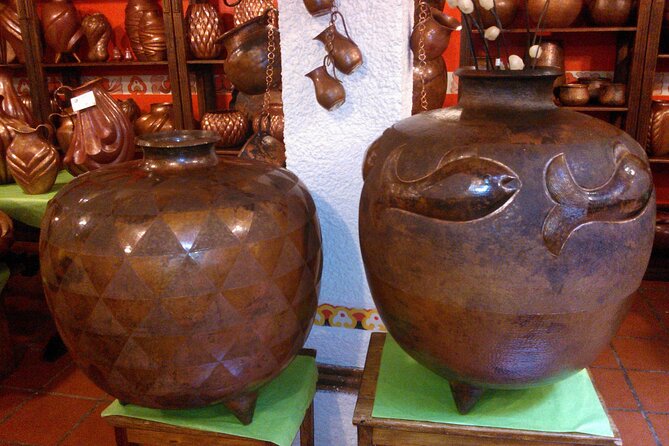
You finish in Santa Clara del Cobre, a town known for copper craft. It’s a simple, enjoyable stop: shops around the main square, about 30 minutes, and entry is free.
The big story tying it to world attention is the copper work for the Olympic flame basin in 1968. That’s the kind of detail that turns a craft town from a local market stop into something with global reach.
What you can expect on the ground is hands-on energy—copper goods everywhere and people working with metal as a living tradition, not a museum exhibit. One of the strongest experiences reported on this route is the chance to try your hand at hammering copper alongside a maestro. The tour data doesn’t guarantee it, but it’s worth asking your guide if there’s an option during your visit.
Even if you don’t do any hands-on work, you’ll still get a clear sense of how the town functions around copper: design, making, finishing, and selling.
Alfredo Tour Guide and why this day feels “guided” instead of rushed
This tour is led by Alfredo Tour Guide, and the big theme from feedback is his combination of professionalism, friendliness, and storytelling depth. People consistently highlight that he doesn’t just point; he explains what you’re seeing and why it matters.
Alfredo is also described as bilingual, which is a genuine advantage if you’re still building Spanish. It can make a difference when you’re hearing explanations about early colonial figures, the meaning behind murals, or how local traditions connect to the landscape and buildings you’re standing in front of.
From the kinds of stories shared on this route, you can expect historical context around places like Bishop Quiroga in Pátzcuaro and details that help you interpret the colonial look of the town. There are also anecdotal moments—like talk about why Pátzcuaro is known for its colors—that make a quick stop feel richer.
The bottom line: the itinerary is short by design, so you’ll get the most value when you use the guide’s explanations. Ask questions as you go. A small-group setup means your questions are more likely to get real answers.
What to watch for on the day: walking, timing, and lunch planning
This is a short-stop day. That’s the trade-off. You’ll likely walk more than you expect because archaeological areas and historic centers rarely have flat, easy routes.
Bring comfortable walking shoes. One review specifically emphasized wearing walking shoes because the day adds up. Also consider sun protection and water—at least one person noted that Alfredo provides water in the car.
Timing can also matter. On one reported instance, the guide arrived late due to car repairs, but the tour was not shortened after the delay. Still, you should mentally budget for the possibility of a late start if something mechanical comes up.
Lunch is not included. That means you’re responsible for finding food, and the timing can make or break the day’s mood. One review named a lunch stop at Restaurant Camino Real, described as warm and local-feeling. The tour may include recommendations, but since lunch isn’t guaranteed in the package, you’ll do best by deciding how you’ll handle meals:
- Eat after the tour if you like long, relaxed meals.
- Or plan to grab something quick during any guide-recommended break.
Either way, don’t show up hungry expecting lunch to appear.
Who this tour suits best (and who might want a different plan)
This is a strong choice if you want a one-day overview of Michoacán’s cultural mix. It’s especially good for people who like seeing how different eras overlap: pre-Columbian temple foundations, early Franciscan architecture, and a living copper craft industry.
It’s also a good fit if you’re staying in Morelia and don’t want the hassle of driving between three separate towns. Private, air-conditioned transportation makes the day feel more controlled.
If your heart is set on one town—especially if Pátzcuaro is your priority—then the short time there may feel limiting. In that case, you might prefer separate time in Pátzcuaro on another day, or pair this with a longer stay later.
Also, this tour lists moderate physical fitness. If you have mobility limits, you might want to consider whether short archaeological walks and uneven ground will be manageable for you.
Should you book 3 Magic Towns from Morelia?
I’d book this if your goal is a smart, guided day that connects three key towns without the logistics headache. For $99, you get private transport, an English-speaking guide, and admissions included at major stops like Tzintzuntzan and the Santa Ana ex-convent. On top of that, Casa de los Once Patios gives you artisan access where you’re seeing lacquerwork with gold-leaf inlay—not just window shopping.
Skip it if you’re the type who needs lots of time in a single place. This is a tight schedule, and Pátzcuaro’s time is brief. It’s also not a lunch-included day, so plan your meal strategy.
If you want a compact Michoacán cultural hit—and you’re comfortable with short site visits—this tour is a solid bet. And if Alfredo is your guide, you’ll be getting more than facts on a route. You’ll be getting help turning what you see into something you understand.
FAQ
How long is the tour?
It runs about 8 hours, starting at 9:00 am.
What does the tour cost?
The price is $99.00 per person.
Where do we meet for the tour?
You meet at Burger King Morelia Centro 2, Guillermo Prieto 30, Centro histórico de Morelia, 58000 Morelia, Mich., Mexico.
Does the price include lunch?
No. Lunch is not included.
Is admission included for the stops?
Admission tickets are included for the Zona Arqueologica de Tzintzuntzan and the Museo Antiguo Convento Franciscano de Santa Ana de Tzintzuntzan. Plaza Vasco de Quiroga, Casa de los Once Patios, and Santa Clara del Cobre are listed as free.
Is the guide available in English?
Yes. The tour includes an English speaking tour guide.
What’s the group size limit?
The tour has a maximum of 8 travelers.
What’s the cancellation policy?
You can cancel for a full refund up to 24 hours before the experience’s start time. If you cancel less than 24 hours before, the amount paid is not refunded.